


What do you need for your half or full triathlon? [Complete advanced guide]
Updated: 13 November 2026
Short answer: for a half or full triathlon you need the same basics as for your first triathlon, but tuned for hours on the course: a trisuit with a long-distance chamois, a supple wetsuit (and a swimskin for when wetsuits are banned), an aerodynamic bike position with aerobars and a hydration system, an aero helmet, triathlon cycling shoes, light running shoes with elastic laces and, above all, a tested nutrition strategy. You will find everything at a glance in the checklist below.
In our triathlon checklist for beginners you can read what you need as a minimum to take part in a triathlon. Got a taste for it and going for a half triathlon (70.3) or even a full one (Ironman distance)? Then quite a lot changes. You are not out there for an hour but for five to seventeen hours, and suddenly comfort, aerodynamics and nutrition weigh heavily. Small annoyances on a sprint become big problems on long distance: a chafing seam, a helmet that does not ventilate, a gel you cannot stomach.
In this guide our triathlon specialists list per discipline what you need for long distance, what is mandatory and what is a smart upgrade compared to your beginner kit. For every discipline we name the models long-distance athletes in our store in Volkel choose most often. Still unsure which distance to go for? Then first read our blog about the different triathlon distances.

In this blog about the gear for your half or full triathlon:
- The complete checklist for the half or full triathlon at a glance (+ free PDF)
- What is different about a half or full triathlon?
- What do you wear the whole race? Trisuit, race number belt and chip band
- What gear do you need for the swim?
- What gear do you need for the bike?
- What gear do you need for the run?
- Nutrition and hydration for long distance
- Transition and your race bag
- Frequently asked questions
The complete checklist for your half or full triathlon at a glance
Everything you need for long distance, per discipline. "Mandatory" is what the rules require, "Recommended" is what virtually every long-distance athlete uses and "Upgrade" is what saves you time or adds comfort once you already own a basic kit. Click the category to see all options.
Download the checklist for the half and full triathlon (PDF)
Print the checklist and tick off what you already own; page 2 covers race day from the evening before to the finish, including what goes into your transition bags and special needs bags.
Still using a beginner kit? Then you do not have to replace everything at once. The upgrades that pay off most are, in this order: a well-fitting long-distance trisuit, clip-on aerobars with a hydration system, an aero helmet and a nutrition plan you have tested in training. Only then the time trial bike and the carbon running shoes.
What is different about a half or full triathlon?
In a half triathlon you swim 1.9 kilometres, ride 90 kilometres and run a half marathon of 21.1 kilometres. In a full triathlon that is 3.8 kilometres of swimming, 180 kilometres of cycling and a marathon of 42.2 kilometres. Depending on your level you are out there for four to seven hours (half) or nine to seventeen hours (full). All distances at a glance are in what are the different triathlon distances?
That duration changes what your gear has to do. Three things suddenly become important:
- Comfort: a chamois that still feels fine after four hours on the bike, flat seams, no chafing zip and shoes your feet can swell in. What is a minor nuisance on a sprint costs you minutes or even the finish on long distance.
- Aerodynamics: over 90 or 180 kilometres drag is your biggest opponent. A low, stable position on aerobars or a time trial bike, an aero helmet and a close-fitting trisuit save more time than a lighter frame.
- Nutrition and hydration: after roughly an hour and a half your carbohydrate stores run out. So you have to eat and drink on the course, and your gear has to make that easy: gel holders on your race number belt, a hydration system on the bars, a hydration belt on the run.
The good news: the basics of your beginner kit remain perfectly usable. Below you can read per discipline what you keep and what is best replaced or added.
What do you wear the whole race? Trisuit, race number belt and chip band
The trisuit for long distance
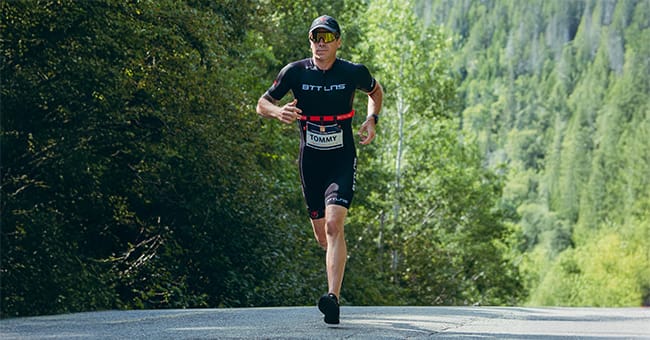
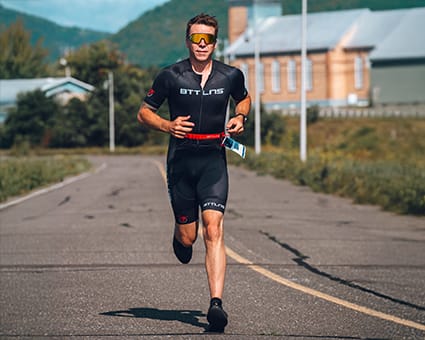
The trisuit (for women: women's trisuits) is the most important piece of clothing in your triathlon: you put it on before the start, wear it under your wetsuit and keep it on until the finish. For long distance you ask more of a trisuit than on a sprint. Look for these points:
- A long-distance chamois: thin enough to swim and run in, but with enough padding for 90 or 180 kilometres in the saddle. This is the biggest difference from an entry-level model.
- Short sleeves: protect your shoulders from the sun and are more aerodynamic than a sleeveless suit. Almost all long-distance athletes choose short sleeves.
- Pockets on the back or thighs: for gels, salt tablets and a bar; on full distance you carry more nutrition than fits in your race number belt.
- Flat seams, a soft collar and a zip guard: anything that could chafe after five hours has to be gone.
- Compression fabric in the thighs: supports your muscles and reduces fatigue in your legs.
For half distance choose a mid-end trisuit such as the BTTLNS Typhon 2.0 SE (number 1 in our top 5, there is also a women's version), for full distance a high-end suit with the best chamois and fabric such as the BTTLNS Nemean 1.0. How to choose the right size and class is explained in need a trisuit: tips for choosing your trisuit; our favourites are in the top 5 best trisuits.

Order before 17:00, delivered tomorrow

Order before 17:00, delivered tomorrow

Order before 17:00, delivered tomorrow
Race number belt and chip band
You wear your race number on your back during the bike and on your stomach during the run. With a race number belt you turn it around in transition in one movement. For long distance choose a belt with gel holders or loops, so you have your nutrition for the bike and run at hand. The chip band goes around your ankle; the timing chip is provided by the organiser and records your split and finish times. A neoprene chip band does not chafe and stays in place even after the swim.


Order before 17:00, delivered tomorrow
What gear do you need for the swim?
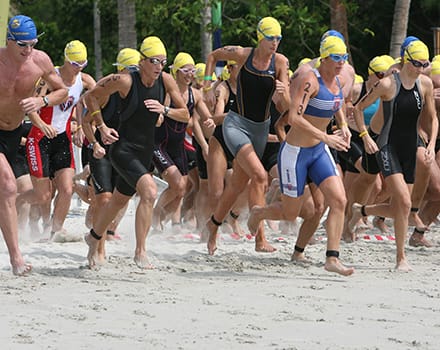
In a half or full triathlon you swim 1.9 or 3.8 kilometres in open water, often with a mass start or rolling start. Your gear has to get you through the water fast and efficiently, so you start the bike with fresh legs.
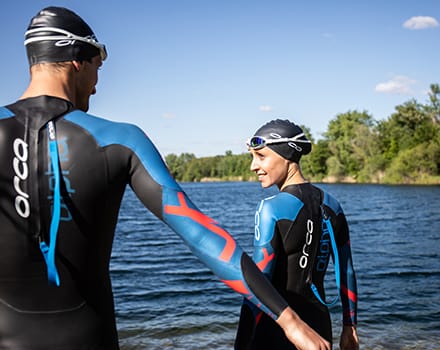
The triathlon wetsuit
A triathlon wetsuit keeps you warm, but more importantly for long distance: it gives buoyancy and a streamlined body position, so you swim faster with less energy. Whether a wetsuit is mandatory, allowed or banned depends on the water temperature on race day; the limits differ per organiser and distance. So always check the rules of your race and prepare for both scenarios.
The difference between an entry-level wetsuit and a higher class is in the neoprene. Top models use Yamamoto neoprene with thicker panels (up to 5 mm) at the hips and legs for buoyancy and thin, supple panels at the shoulders for a free stroke. Over 3.8 kilometres in particular you notice the difference: less tired shoulders and a better body position when your technique fades after an hour. Fit remains the most important thing: too loose lets water in, too tight restricts your breathing.
How to choose the right wetsuit is explained in how to choose the right wetsuit for a triathlon? and our recommendations are in the top 5 best triathlon wetsuits.


Order before 17:00, delivered tomorrow

Wetsuit banned? Then you swim in a swimskin
In warm water the organiser may ban wetsuits. If you then swim in just your trisuit, it soaks up water and slows you down. A swimskin goes over your trisuit: the water-repellent fabric and taped seams fit tightly, so you lie almost as streamlined as in a wetsuit, without the buoyancy. In transition you take it off in a few seconds.
If you race in southern Europe or in summer, a swimskin is not a luxury but a must. It is also pleasant on warm open-water training days.

Delivery within 1 – 2 business days

Delivery within 3 – 7 business days
Delivery within 3 – 7 business days
Swimming goggles, swim cap and anti-chafing stick
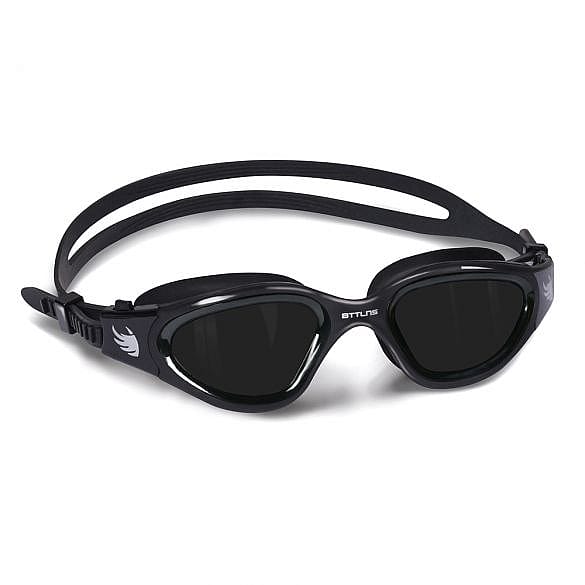
For open water choose swimming goggles with a wide field of view and a lens that suits the conditions: a polarized lens or mirrored lens in bright sunlight and reflections, a photochromic lens when the light changes. Look for a good seal and anti-fog; in a mass start the goggles must not stick out too far. The three best-tested goggles from our top 7 open water swimming goggles are shown below; how to choose is explained in how to choose the best swimming goggles?
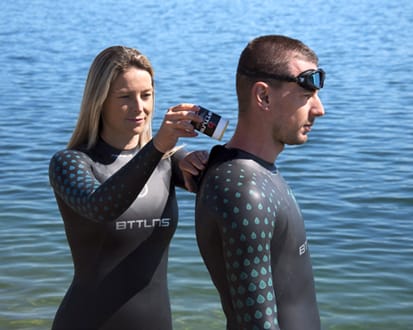
A silicone swim cap is mandatory; you usually get one from the organiser, but always bring a spare. If you train in cold water in spring, a neoprene swim cap is pleasant (almost never allowed in races). Before the start, apply an anti-chafing stick to your neck, armpits and groin: on long distance a wetsuit or trisuit is otherwise guaranteed to chafe.

Order before 17:00, delivered tomorrow

Delivery within 2 – 4 business days
Order before 17:00, delivered tomorrow
What gear do you need for the bike?
The bike is the longest discipline: 90 or 180 kilometres, on which you sit for two to seven hours. This is where you win or lose the most time and where you eat and drink the most. Almost every long-distance upgrade is therefore on the bike.
Road bike or time trial bike, aerobars and hydration system
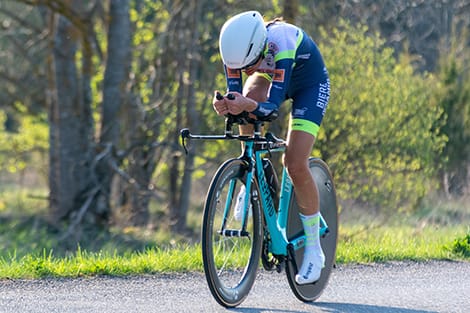
A good road bike is enough for your first half triathlon. The biggest gain is not in a new frame but in your position: with clip-on aerobars on your road bike you sit lower and narrower, which quickly saves minutes and watts over 90 kilometres. Do have the position fitted and train in it, because an aero position demands flexibility in your hips and back.
If you plan to do long distances more often, a time trial bike is the next step: a steeper seat angle, integrated cockpit and aerodynamic tubes. The difference from a road bike with aerobars is smaller than often thought; a well-fitted road bike beats a badly fitted time trial bike.
Also mount a hydration system between your arms or on the frame, so you can drink without leaving your aero position, and enough bottle cages for the amount of fluid you need for your distance. Tape your gels to the top tube or use a bento box.


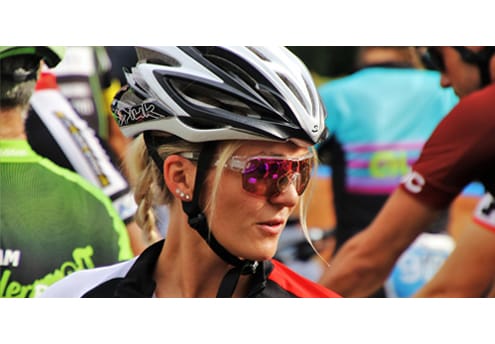
Cycling helmet or aero helmet and cycling glasses
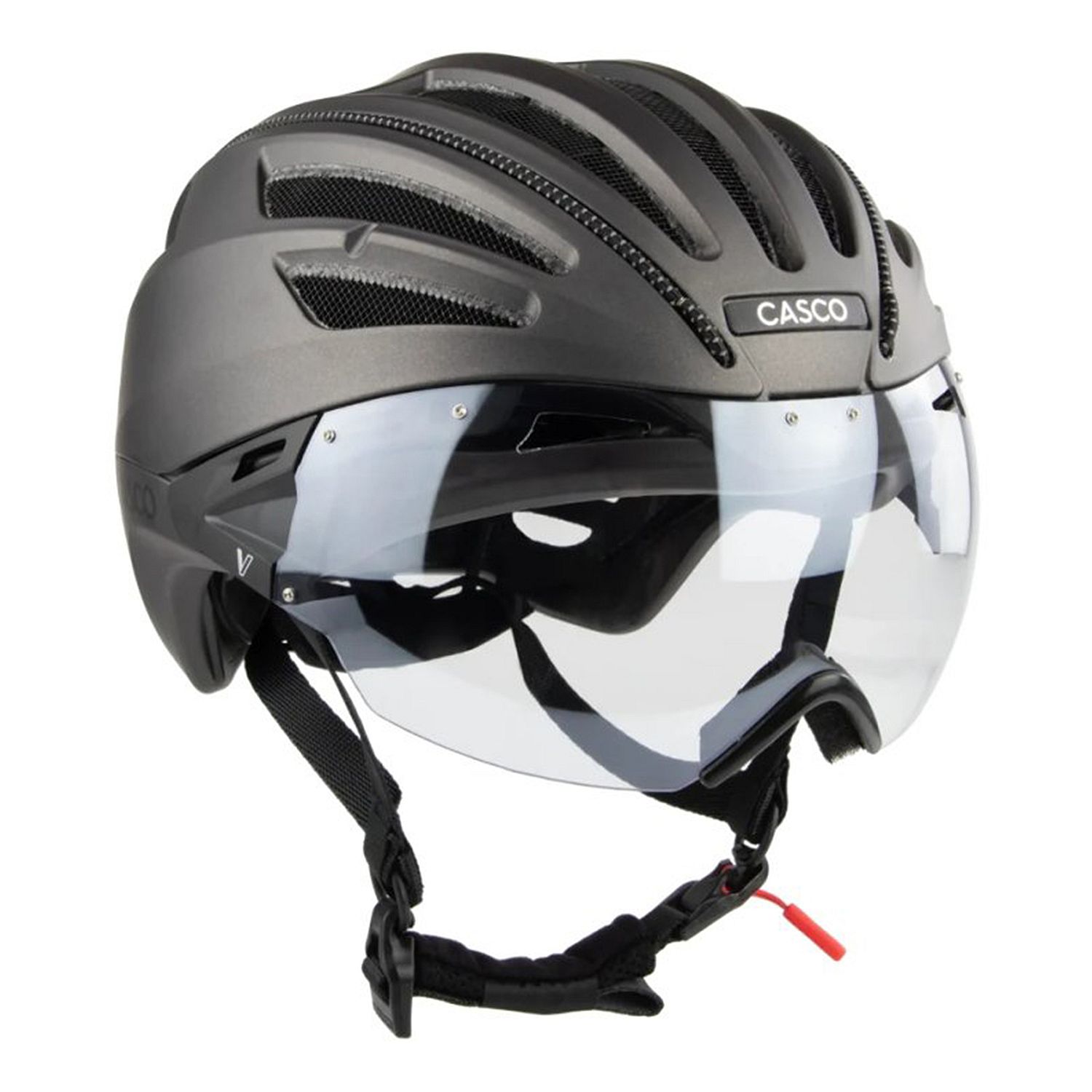
A cycling helmet is mandatory and must be fastened before you touch your bike in transition. For long distance you choose between a well-ventilated road helmet and an aero helmet. An aero helmet saves drag, but only if you stay stable in your aero position; if you look around a lot or sit upright, it works against you. Modern aero helmets with a short tail and vents are a good middle ground for hot days.
Cycling glasses protect your eyes from UV, wind, insects and spray. Choose glasses with a large field of view and interchangeable or photochromic lenses, so you keep good vision at the morning start and in the afternoon sun.

Delivery within 2 – 4 business days

Delivery within 2 – 4 business days
Cycling shoes, gloves and socks
With clipless pedals you pedal in circles instead of only pushing down, and that counts over 90 or 180 kilometres. Triathlon cycling shoes have one wide velcro strap that opens outwards and a loop on the heel, so you get them on and off in a flash; many athletes leave them clipped into the pedals and step in while rolling. Good road cycling shoes will do as well, but cost you a few seconds in transition.
Cycling gloves are optional, but on full distance gel padding prevents numb hands and they protect you in a crash. Socks or not is a personal choice: test it in training. On full distance most athletes do wear socks against blisters; dry your feet well in transition.
View triathlon cycling shoes View all road cycling shoes
Repair kit and tools
During the race you are not allowed outside assistance, so you fix a flat yourself. Bring at least: a spare inner tube or a tubeless plug kit, a CO2 cartridge with adapter or a mini pump, tyre levers and a multitool. Store them in a saddle bag or a bento box and check your bike the day before the race: tyre pressure, brakes, gears and whether your derailleur battery is charged. More about your bike kit in what do you need for cycling?


What gear do you need for the run?
After the bike comes a half or full marathon on tired legs. You keep your trisuit on; you only change shoes and grab your cap and nutrition. Comfort beats weight here: the fastest shoe does not help if you cannot run in it anymore after 25 kilometres.
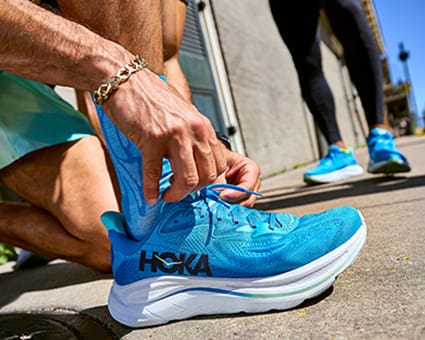
Running shoes for long distance
For a half or full marathon after 90 or 180 kilometres of cycling you want a light shoe with plenty of responsive cushioning. Super trainers and racing shoes with a carbon or Pebax plate return energy and relieve your calves, but demand stable legs and good running form; test them first on your long runs. If you are a bit heavier built or aiming to finish rather than for a time, a well-cushioned daily trainer is the safer choice.
Take half a size extra room: your feet swell after hours of cycling and running. Combine the shoe with elastic laces, so you do not have to tie anything in transition. Which shoe suits your running style is explained in 7 tips for choosing the right running shoes.

Delivery within 2 – 4 business days

Delivery within 2 – 4 business days

Delivery within 2 – 4 business days
Visor or cap, compression and hydration belt
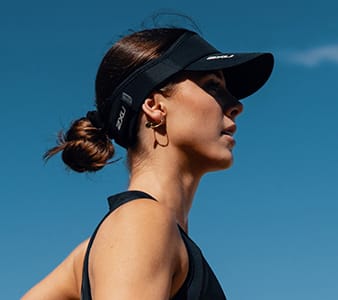
A visor or running cap keeps sun, sweat and rain out of your eyes; a visor is cooler, a cap also protects your head. On hot race days you tuck ice or a wet sponge under it at the aid stations. Compression calf sleeves or socks support your calves and are especially pleasant if you are used to them from training; do not wear them for the first time on race day. A hydration belt gives room for gels, salt tablets and a bottle of your own sports drink, handy if you do not want to depend on what the organiser hands out.


Delivery within 1 – 2 business days

Sports bra for women
For women a good compression sports bra is essential: it prevents sore breasts and back complaints on long distance. Choose a model with flat seams that is also comfortable under your wetsuit and trisuit and dries quickly after the swim. View the sports bras for triathlon.
Nutrition and hydration for long distance
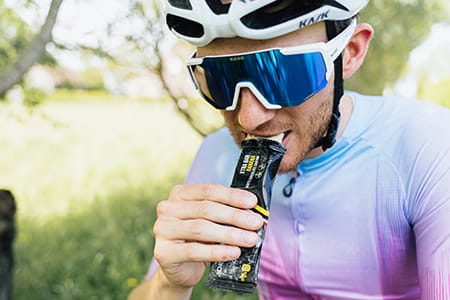
On a sprint you get away with a bottle of water; on half or full distance your nutrition decides whether you finish. Your body stores carbohydrates for about an hour and a half, after that you have to top up. Most long-distance athletes aim for 60 to 90 grams of carbohydrates per hour on the bike and slightly less on the run, from a combination of sports drink, gels and possibly a bar. On top of that you drink 500 to 750 ml per hour, depending on the temperature, and replace salt with electrolyte or salt tablets.
The golden rule: nothing new on race day. Test your gels, drinks and quantities in your long training sessions and train your gut. Check beforehand which sports drink and gels the organiser hands out; if you do not want to use them, carry your own nutrition in your trisuit pockets, race number belt, bento box and hydration belt. More about sports drinks in why do you need a sports drink?


Delivery within 2 – 4 business days

Transition and your race bag
At many half and full triathlons you hand in your gear the day before the race: your bike in transition and your bike and run gear in separate transition bags (bike bag and run bag). On full distance there are often also special needs bags that are handed to you halfway through the bike and run, ideal for extra gels, a spare inner tube or a dry cap. Read the race guide carefully and pack your bags with a checklist.
This is what goes into our specialists' bags:
- Bike bag (T1): cycling helmet, cycling glasses, cycling shoes (or already in the pedals), cycling gloves, socks, nutrition for the bike, sunscreen, small towel.
- Run bag (T2): running shoes with elastic laces, visor or cap, hydration belt with gels and salt, possibly compression calf sleeves and dry socks.
- Before the start: wetsuit or swimskin, goggles plus spare goggles, swim cap, anti-chafing stick, race number belt and chip band, a bottle of water and a gel for just before the start.
- After the finish: dry clothes, flip-flops, recovery shake or bar and a warm jacket.
A roomy triathlon bag with compartments per discipline keeps everything organised. Pack it the evening before using the checklist at the top of this blog.
Frequently asked questions about gear for a half or full triathlon
Do I need a time trial bike for a half triathlon?
No. A well-fitted road bike with clip-on aerobars is fine for most half and even full triathlons. A time trial bike is an upgrade that pays off if you ride long distances more often and have mastered your aero position.
What is the difference between the gear for a half and a full triathlon?
The list is the same; the difference is in comfort and nutrition. For full distance you choose a trisuit with the best chamois and more pockets, carry more nutrition and fluid (and use the special needs bags), usually wear socks and choose running shoes for cushioning rather than weight.
What if wetsuits are banned on race day?
Then you swim in a swimskin over your trisuit. A swimskin gives no buoyancy but does give a streamlined position. Always bring one if the water temperature could be around the limit in the rules.
Which trisuit is suitable for a full triathlon?
A high-end trisuit with short sleeves, a long-distance chamois, flat seams and pockets for nutrition. Try it on with your wetsuit over it and test it on a long brick session before wearing it in a race.
How many gels do I take?
Count on 60 to 90 grams of carbohydrates per hour. A gel usually contains 22 to 40 grams, so two to three gels per hour on the bike if you otherwise only drink water, fewer if you use sports drink. Always bring a few extra.
Can I run with earphones or music?
No, at virtually all triathlons earphones, music and phones are banned during the race, including on the run.
Should I wear socks in a half or full triathlon?
On half distance many athletes run without socks to save time; on full distance almost everyone wears socks against blisters. Test both in training and apply anti-chafing stick to your feet.
How far in advance should I test new gear?
At least four to six weeks before the race, so you have used every item in a long brick session: wetsuit, trisuit, aero position, shoes and above all your nutrition.
Need help choosing your long-distance gear?
Our triathlon specialists race half and full triathlons themselves and are happy to help you with the right trisuit, wetsuit, aero position or nutrition strategy. Reach them on +31 (0)85 773 00 58, send an e-mail or visit our triathlon store in Volkel to try on wetsuits and trisuits.
Also worth reading


