What is running cadence?
Imagine this: you're on a relaxed long run on a Sunday morning. Your breathing is steady and your legs feel good, but still… something isn't quite right. You keep landing just a little too heavily, your rhythm feels forced, and after ten kilometres your knees start to complain. Chances are the cause isn't your shoes, your route or your nutrition, but your cadence.
Cadence is one of the most underrated yet influential factors in running. It determines how smoothly you run, how much impact your body has to absorb, and how much energy you waste (or save). Whether you're running your first 5 kilometres, training for a marathon or you're a triathlete stepping off the bike in T2: your step rate affects your entire running efficiency.
Yet many runners don't know exactly what cadence is, let alone how to measure or improve it. And that's a shame. Because by consciously optimising your cadence, you can:
- Prevent injuries
- Improve your running economy
- Run paces more effortlessly (without having to train harder)
That's why in this blog we take a closer look at the world of running cadence. What exactly is it? How does it work biomechanically? Why do elite athletes run with such a rapid rhythm? And even more importantly: how do you apply it in your own training, whether you run recreationally or are chasing a PR?
In this blog about running cadence:
- What exactly is cadence?
- Why is the right cadence important?
- The biomechanics behind cadence
- How cadence affects your energy use and improves running efficiency
- Injury prevention thanks to a higher cadence
- Cadence over long distances, marathons & triathlons
- How to measure your own cadence
- Myths about the 'ideal' cadence
- Improving your cadence: how to go about it
- Conclusion
What is running cadence?
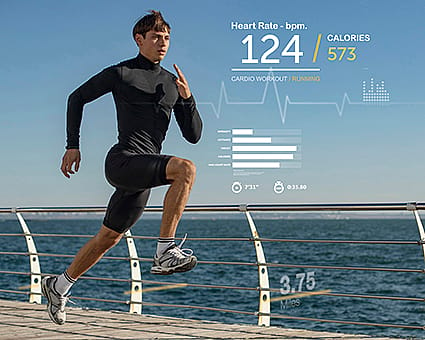
Cadence is the number of steps a runner takes per minute, expressed in steps per minute (SPM).
If you've ever watched a professional runner or triathlete, you may have noticed how quickly their feet hit the ground. That rhythm is called cadence. It's a simple but powerful parameter: cadence says nothing about how fast you run, but about how often your feet touch the ground. If you take 90 steps with your right foot in one minute, your total cadence is 180 SPM.
Why is the right cadence important?
A good cadence is more than a number on your sports watch – it's the basic building block of an efficient, injury-free running technique. By running at the right step rate, you waste less energy moving forward (better running economy), reduce the impact on your joints and get more out of every step.
Among other things, the right cadence provides:
Stride length and cadence together determine your running speed
A common misconception is that your speed depends only on your stride length. In reality, speed is the product of two factors:
Speed = cadence × stride length
For example:
- Cadence = 180 steps per minute
- Stride length = 1.1 metres per step
- Speed = 180 × 1.1 = 198 metres per minute
- 198 metres per minute × 60 minutes = 11,880 metres per hour
- Speed = 11.88 km/h
This means you can run faster by either:
- Taking more steps per minute (higher cadence)
- Taking bigger steps (longer stride length)
- Or a combination of both
Many recreational runners automatically try to go faster by lengthening their stride, but that often leads to overstriding: you land too far in front of your body, which causes more impact and a higher risk of injury. A higher cadence, on the other hand, keeps your steps shorter, more controlled and more efficient.
Stride length is the distance you cover with one complete step, so from the moment one foot touches the ground until the other foot touches the ground.
In running terms, we usually mean the distance per step, not per stride (some count left-right as one stride, but in most sports science contexts each step is counted separately).
Example:
If you run at a cadence of 170 steps per minute and your speed is 10 km/h, your average stride length is about 0.98 metres.
You can calculate your stride length with the following formula:
Stride length = speed ÷ cadence (in steps per second)
For example:
- Speed = 10 km/h = 166.7 metres per minute
- Cadence = 170 steps per minute
- Stride length = 166.7 / 170 = approx. 0.98 metres per step
So stride length and cadence together determine your running speed.
Long stride length and low cadence = risk of overstriding
Short stride length and high cadence = often more efficient and kinder to your body
The biomechanics behind cadence
Cadence may seem like a small detail, but it says a lot about how efficiently and naturally you move while running. Small changes in your step rate have a direct effect on how your body moves, how it's loaded and how much energy it uses.
How a higher cadence helps prevent overstriding
Overstriding means placing your foot on the ground well in front of your centre of gravity, often with a straight knee and a heel strike. This causes:
- A braking effect with every step
- Extra load on your knees, hips and lower back
- An increased risk of injury
A higher cadence automatically makes your steps shorter. As a result, you land more underneath your body, with a slightly bent knee. Your feet stay closer to your centre of gravity, which leads to a smoother, safer roll-off with every step you take.
Higher cadence = less impact per step = lower injury risk
Shorter ground contact time = more efficient running
With a low cadence, your feet stay on the ground longer, which increases energy loss. With a higher cadence, ground contact time is shorter, leading to:
- Better springiness and rhythm
- More efficient energy transfer
- Less deceleration with every step
Research shows that elite runners have a shorter ground contact time and a higher cadence than recreational runners. This makes their running pattern smoother and more energy-efficient, especially over long distances such as marathons or the run legs of triathlons.
Better running technique through a higher cadence
A higher cadence forces you into a more active running pattern:
- Your posture becomes more upright
- Your core is engaged better
- You land more often on your midfoot instead of your heel
- You keep a smoother rhythm, even when fatigued
By gradually increasing your cadence (e.g. by 5% compared with your current rhythm), you improve your running technique without drastic changes. This makes it an accessible and safe way to learn to run more efficiently, whatever your level.
How cadence affects your energy use and improves running efficiency
Running isn't just a matter of fitness – it's also about using your energy wisely. Your body is constantly looking for a balance between effort and saving energy. Your cadence plays a bigger role in this than many runners realise. A well-tuned step rate contributes directly to your running economy (how much energy you use to cover a certain distance).
Cadence as a factor in your running economy
Runners with an efficient cadence move more smoothly and with less waste. With a cadence that's too low, you often take bigger steps, which leads to:
- Harder landings
- Longer ground contact
- More vertical movement (up and down)
This costs extra energy that you'd rather use to move forward. A higher cadence limits those inefficient movements. Your feet stay closer to the ground, your running pattern becomes smoother and your energy is converted more effectively into forward speed.
Higher cadence = less waste = more energy left for pace or distance
Less energy loss thanks to a faster step rate
A faster cadence means more, but shorter, steps. That sounds more tiring, but the opposite is true. By turning your legs over faster:
- Your foot gets back under your body more quickly
- You have less 'flight time', which reduces downward impact
- It becomes easier to keep running at a steady rhythm
Your muscles have to correct less on landing, which means less fatigue and muscle strain, especially on long runs or after cycling in a triathlon.
How elite runners make optimal use of elastic energy
Top athletes such as Eliud Kipchoge seem to run effortlessly, but what you're seeing is biomechanical perfection. Their high cadence helps activate the natural elastic energy in tendons and muscles, especially in the Achilles tendon and the arch of the foot.
With every step, part of the impact is temporarily stored as elastic tension, which is immediately returned during push-off. Compare it to a spring: the faster you move with the right timing, the more efficiently you use that energy.
Injury prevention through the right cadence
Injuries are a runner's biggest spoilsport, especially during long-distance training or intensive triathlon blocks. Fortunately, one of the most accessible and effective strategies for reducing injuries is optimising your cadence.
Impact on knees, shins and hips at low vs. high cadence
A low cadence (for example below 160 SPM) often means that:
- You land on your heels with more force
- Your knee is fully extended on landing
- Your shins are put under extra load by the braking effect
- Your hips have to absorb more shock
A higher cadence (170–190 SPM), on the other hand, results in:
- Shorter steps
- Landings closer to your centre of gravity
- A bent knee on impact
- Less vertical shock load
Research shows that increasing your cadence by 5–10% significantly reduces peak loads on the knees, shins and hips, without compromising speed or performance.
What research says about a 5–10% increase in cadence
Scientific studies, such as that by Heiderscheit et al. (2011), show that gradually increasing your cadence by 5–10% leads to:
- 14–20% less load on the knees
- Reduced braking force with every step
- Lower load on the tibia (shinbone) and hip
What's more, this adjustment is easy to sustain, provided you build it up gradually and combine it with targeted running drills.
Practical examples for common injuries
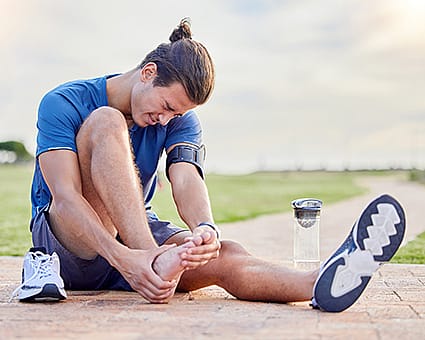
1. Knee pain (runner's knee)
In many runners, knee pain is caused by overloading the knee joint with every landing. By increasing your cadence, you reduce the extension of the knee on impact and therefore the pressure on the kneecap.
2. Shin splints (medial tibial stress syndrome)
Overly long strides cause hard heel strikes and high tensile forces on the shinbone, which can lead to shin splints. A higher cadence reduces those forces, lowers the shock load and improves your running pattern.
3. Hip complaints (such as gluteus medius overload or bursitis)
At a low cadence, sideways movement is greater and the hip has to do more stabilising. A faster cadence makes your running more compact, with less 'wobbling' and more control from your core, which can reduce the risk of hip complaints.
Curious about the most common running injuries? Then also read our blog about the 10 most common running injuries.
Tip: don't increase your cadence abruptly. Start with a 5% increase above your natural rhythm and build this up gradually over 6 to 8 weeks.
Cadence over long distances, marathons & triathlons
During an easy long run, a slightly lower cadence may not be noticeable. But when you're training for a marathon or triathlon, cadence plays an important role in your efficiency, pace recovery and fatigue management. The longer the effort, the greater the impact of your step rate on your performance and your injury risk.
Typical cadence of marathon runners
Elite marathon runners often run at a cadence of between 180 and 190 SPM, even at easy paces. Recreational marathon runners average between 160 and 175 SPM. That lower rate often results from:
- A longer stride at lower speeds
- Less focus on technique
- Increasing fatigue in the second half of the race
Still, maintaining a stable cadence during a marathon is important. Not only to keep your rhythm, but also to prevent your running efficiency from collapsing when your body gets tired.
A drop in cadence as a sign of fatigue
Over long distances, a falling cadence is often one of the first signs of fatigue setting in. When your muscles fatigue or your core stabilises less well:
- Your strides lengthen without you noticing
- You lose your feel for rhythm
- Your landings become heavier and less stable
Consciously focusing on cadence in the second half of your race (the moment you notice that fatigue is building and your technique or rhythm is slipping) helps you stay in an efficient running rhythm, even when your legs feel heavy.
Tip: during your long training runs, also include 'negative split' cadence blocks (where you run at a slightly higher cadence than in the first half of your race or session): try to maintain a slightly higher cadence over the last 5 km than at the start.
Triathlon: the importance of a fast step rate after cycling (the "brick")
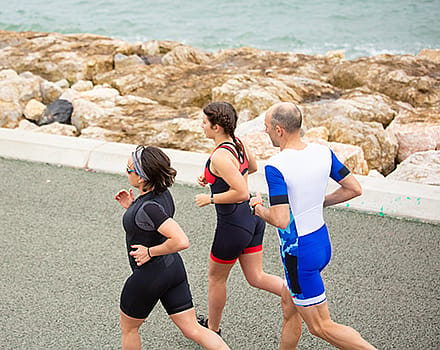
For triathletes, the transition from cycling to running is a crucial moment. Your legs feel heavy, your balance is briefly off and your rhythm seems to have disappeared. In this "brick run" situation, cadence gives you something to hold on to:
- A high cadence (180+ SPM) helps you find a rhythm quickly
- It stops you from starting with heavy, slow steps
- You minimise the muscle shock caused by overloading tired muscles
Many experienced triathletes specifically train their cadence on runs straight after cycling. By consciously maintaining a high step rate, you activate your neuromuscular system faster and reduce that 'jelly legs' feeling.
The relationship between cycling and running cadence in triathletes
Cadence also plays a role on the bike. Most triathletes cycle at a pedalling cadence of between 80 and 95 RPM (revolutions per minute). Research shows that a high cadence before running makes the transition in T2 (from cycling to running) easier.
Why? Because moving from fast, spinning movements on the bike to a high step rate while running provides:
- Continuity in rhythmic movement
- Faster switching between muscle groups
- Less stiffness in the hips and hamstrings
Tip for triathletes: regularly simulate the transition from bike to run in your training, and focus extra on building up your cadence straight away.
How to measure your own cadence
To improve your cadence, you first need to know where you stand. Fortunately, cadence is easy to measure these days, both while running and afterwards in training apps.
1. With a sports watch or running app
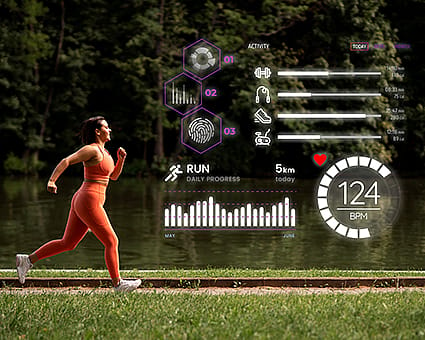
Most modern GPS sports watches automatically measure your cadence using a built-in motion sensor (accelerometer) or a foot pod. Think of:
- Polar, Garmin, Suunto or Coros watches
- Apple Watch (certain models with running analysis)
- Foot pods such as the Stryd or Garmin Running Dynamics Pod
What you'll see in your data:
- Cadence in SPM (steps per minute)
- Sometimes: left/right cadence separately (for asymmetry analysis)
- Average and peak values per kilometre
Most watches show this in real time on your screen, or afterwards in the app.
Pro tip: set up a real-time cadence screen on your watch or use a vibration alert when you deviate, if your watch supports this.
2. Measuring manually without technology
Don't have a sports watch, or want to experience it yourself? Then measure your cadence with a simple stopwatch:
- Count the number of times your right foot touches the ground in 30 seconds
- Multiply this number by 4 = your total cadence (left + right)
Example: if you count 43 right-foot steps in 30 seconds, your cadence is 172 SPM.
Note: try to do this at a steady pace (constant, even speed) on flat terrain – during intervals or on hills your cadence fluctuates more.
3. Cadence apps and metronome tools
Want to actively work on your cadence while running? There are apps and tools that give you metronome beeps at the desired SPM:
- Metronome for Running (iOS/Android)
- Beats Per Minute apps
- Spotify playlists with a fixed BPM (e.g. 180 BPM running)
By running to the rhythm of the beat, you train your body into an even, faster running pattern. This is often used in injury rehabilitation or running technique training.


Myths about the 'ideal' cadence
Ask ten runners what the perfect cadence is, and you'll almost always get the same answer: 180 steps per minute. But is that right? And does it apply to everyone? The reality is more nuanced than is often thought. Time to debunk a few misconceptions.
Where does the figure of 180 SPM come from?
The figure of 180 SPM became popular through the work of Dr Jack Daniels (the well-known running coach, not the whiskey – you won't see much of that on the course). At the Olympic Games in the 1980s, he observed that most top athletes ran at around 180 or higher, often between 180 and 200 steps per minute.
That led to the myth: "180 SPM is the ideal cadence for everyone." But Daniels already stressed at the time that this only applied to trained elite athletes at top speed, not to recreational runners at an easy pace.
What works for a professional marathon runner doesn't automatically work for a 1.95 m recreational runner doing his 10 km on a Sunday morning.
Why 180 SPM isn't a universal standard
There's no magic number that's optimal for every runner, every body and every pace. What works for you depends on several factors:
- Height: taller runners naturally have longer legs and will usually run at a slightly lower cadence, without this being inefficient.
- Speed: your cadence often rises by itself at higher speeds. On a long run your cadence might be 165, but during interval training 185.
- Running style and technique: forefoot or midfoot runners often have a higher cadence than heel strikers because they roll off faster. Hip mobility, core stability and running efficiency also play a part.
"More cadence = faster" isn't always true
Another persistent misconception is that a higher cadence automatically leads to a faster time. But speed is the product of:
Speed = cadence × stride length
If your cadence rises but your stride length drops sharply, your net speed can actually decrease. The trick is to find your personal optimum: the highest efficiency with the least wasted energy and injury risk.
In short: don't fixate on the number 180. Use cadence as a tool, not as the holy grail.
Improving your cadence: how to go about it
Want to run more efficiently, injury-free and more smoothly? Then optimising your cadence is a smart move – provided you approach it gradually and consciously, of course. Increasing your cadence through brute force or by forcing it will actually lead to complaints.
Determine your starting point and increase by no more than 5%
Before you change anything, you need to know your current cadence. Use a sports watch, an app or the manual counting method to determine your natural cadence during a normal easy run.
Then:
- Add 5% to your average cadence
- Example: cadence = 164 → new target cadence = 172
- Use this as a guideline during specific training sessions
Never increase suddenly by 10–15 SPM. Your body needs time to adapt to the new movement pattern.
Cadence intervals and metronome training
An effective way to increase your step rate is with cadence intervals. You alternate short blocks at a higher cadence with blocks at your normal rhythm. For example:
- 4× 2 minutes at target cadence (e.g. 172)
- 2 minutes at your normal cadence in between
If you like, use a metronome app or a music playlist with a fixed BPM (for example 175 or 180 BPM). This helps your body learn the rhythm without overloading it.
Examples of cues: "light steps", "run quietly"
Mental prompts, or cues, help you subtly influence your running style. Effective cues that increase cadence without forcing it:
- "Light steps": avoid landing hard
- "Run quietly": focus on a quiet landing and soft foot placement
- "Quick feet": keep ground contact active and short
- "Short steps": helps avoid overstriding
Use only one cue at a time per session to stay focused.
Strides, hill training and rhythmic running
Improving your cadence isn't just about counting. Specific types of running also help:
- Strides (short accelerations): 4–6 repetitions of 80–100 metres, relaxed but fast. Your cadence rises by itself.
- Hill training: short hills force you into short, quick steps with an active push-off.
- Rhythmic running to music: run with a 170–180 BPM playlist for a natural increase in cadence.
Expect to adapt within 6–8 weeks
Changing your running pattern takes time. Give yourself at least 6 to 8 weeks to let your body and nervous system get used to the new rhythm. In the beginning, expect:
- Muscle fatigue in your calves or hamstrings
- A higher heart rate at the same speed
- Sometimes even a temporarily slower pace
But over time you'll notice that you run more efficiently, with less strain and a smoother rhythm.
The effect of running shoes on your cadence
Do running shoes affect my cadence too? Although your cadence is mainly influenced by your technique and rhythm, the right running shoes can play a supporting role. Lightweight shoes with a responsive midsole (such as carbon or PEBA foam) often encourage a faster step rate thanks to their direct ground contact and energy return. The 'drop' of a shoe (the height difference between heel and forefoot) can also influence your running pattern: shoes with a lower drop encourage more of a midfoot or forefoot landing, which suits a shorter, faster stride.
Note: don't switch shoe types too quickly. Build up the transition gradually, especially if you're moving from a traditional cushioned shoe to a more responsive model. Always combine new shoes with running drills to improve your cadence for the long term.
Conclusion
Running isn't just about speed or distance, but about efficiency. And your cadence is one of the most powerful – and often forgotten – links in that chain. It affects your technique, energy use and injury risk. By understanding your step rate and optimising it step by step, you'll get more out of every training session without having to work harder.
Whether you're building up the kilometres in the run-up to a marathon, coming out of T2 as a triathlete, or simply want to run with more enjoyment and fewer complaints: cadence is your secret weapon. Not magic, but measurable. Not complicated, but effective.
So get started. Count your steps, feel the rhythm and discover how small adjustments make a world of difference.
Also worth reading